A Realistic Timeline for a Custom Fragrance Project
A custom fragrance project is two clocks running at once: a development clock that responds to decisions, and a physical clock — resting, stability, compatibility — that responds to nothing at all. Schedules slip when the two are planned as one line. Build the calendar around the fixed intervals, arrange the decisions to fit them, and a twelve-to-twenty-week launch becomes predictable rather than optimistic.
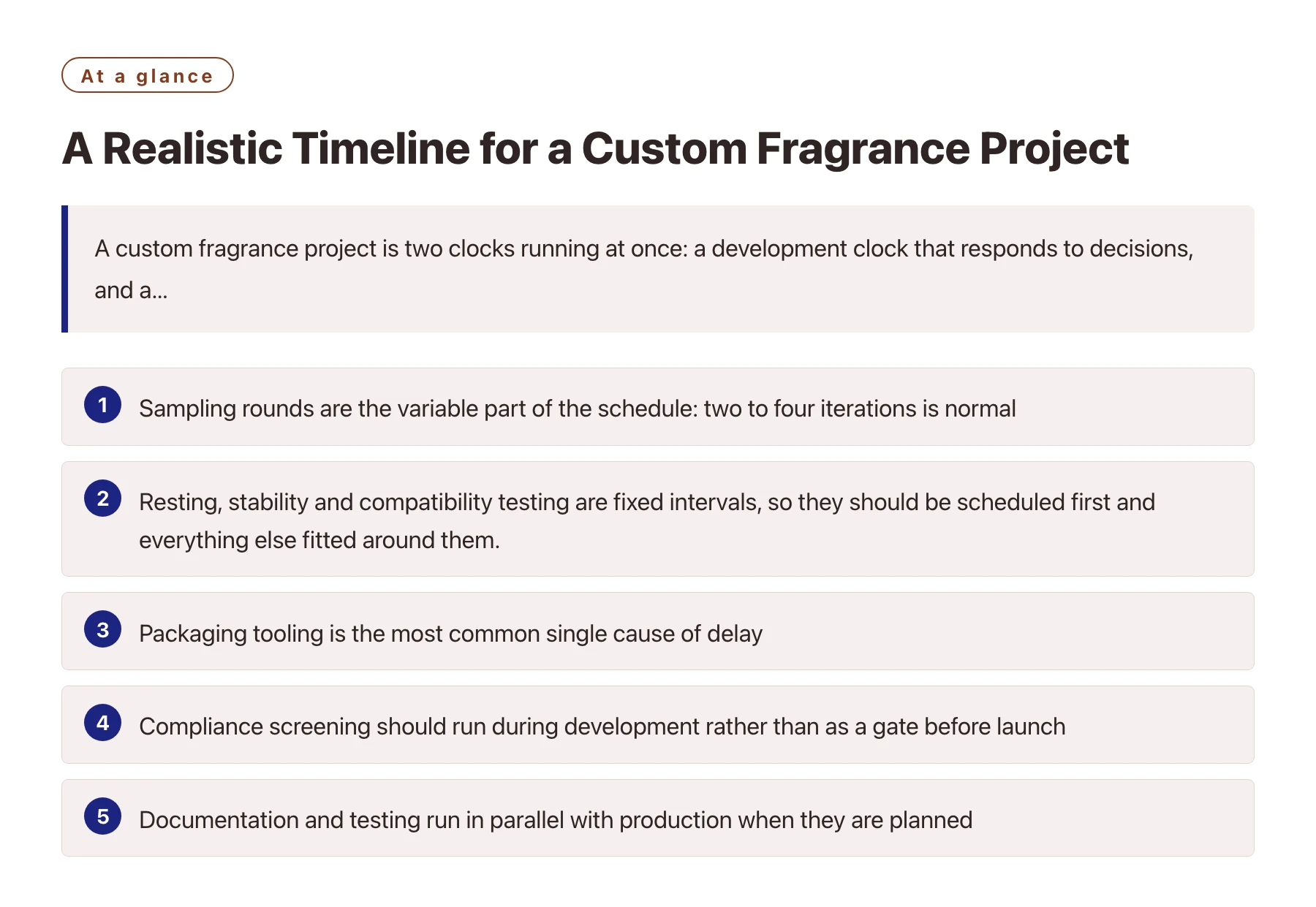
Key takeawaysSampling rounds are the variable part of the schedule: two to four iterations is normal, and each round costs more than the calendar shows because packaging work often waits on it. · Resting, stability and compatibility testing are fixed intervals, so they should be scheduled first and everything else fitted around them. · Packaging tooling is the most common single cause of delay, because a new mould has to be made, sampled and approved before filling can be planned. · Compliance screening should run during development rather than as a gate before launch, since restrictions on fragrance materials are revised periodically [1]. · Documentation and testing run in parallel with production when they are planned, and in series when they are not [2].
Brands usually build a launch calendar by working backwards from a retail date and allocating generous-looking blocks to each stage. The blocks look reasonable individually and fail collectively, because two or three of them cannot run at the same time unless someone deliberately arranges it.
This is a planning article rather than a promise about any particular factory. Durations differ by product, market and supplier, but the shape of the schedule is consistent enough to plan against.
The table below sets out where the weeks actually go in a typical fine fragrance or home fragrance project.
Where the calendar goes
| Stage | Planning range | Who controls it | What usually delays it |
|---|---|---|---|
| Brief and feasibility | 1–2 weeks | Brand and supplier | An undefined price point or channel |
| First samples | 2–4 weeks | Supplier | Materials that have to be sourced specially |
| Sampling iterations | 2–6 weeks | Brand-driven | Feedback that restarts the direction instead of narrowing it |
| Compliance screening | 1–2 weeks, parallel | Supplier and brand | Being treated as a final gate rather than a running check |
| Resting and maceration | 2–6 weeks | Physical process | Tank time not reserved in advance |
| Stability and compatibility | 4–12 weeks, parallel | Laboratory | Commissioned after the packaging is frozen |
| Packaging tooling and decoration | 4–12 weeks | Component suppliers | New moulds, new decoration methods, artwork revisions |
| Bulk production and filling | 2–5 weeks | Supplier | Component arrival, line availability, batch re-work |
| Documentation and release | 1–2 weeks | Supplier and laboratory | Test reports requested late |
The ranges overlap on purpose. A schedule that adds these numbers together will be two to three times longer than the project needs to be.
The two clocks, and why they behave differently
The development clock is a decision clock. It moves when a brand gives clear feedback, and it stalls when feedback is vague or when several stakeholders have to agree. Nothing about it is physically fixed, which makes it the part of the schedule most worth managing closely.
The physical clock is the opposite. A concentrate that needs to rest will rest, and a stability study measures change over weeks rather than days. Neither can be accelerated with a bigger order or a firmer deadline. The planning implication is straightforward: identify the fixed intervals first, then place the decisions around them.
The sampling loop
Most projects need two to four rounds. The first round explores the direction, the second corrects it, and later rounds fine-tune materials or strength. Rounds get expensive when the brief changes between them, because the supplier effectively restarts rather than narrows. Keeping a written record of what was rejected and why is the cheapest schedule protection available.
Suppliers with in-house development usually run this loop faster, since the person who formulates is the person who adjusts. That is one of the practical differences between working with a standalone development studio and working with a perfume production partner in China that does both, and it is worth asking about explicitly rather than assuming.
The stability clock
Stability testing observes the product over time, often under accelerated conditions as well as ambient ones, and it cannot be replaced by an opinion. Compatibility testing between the concentrate and the pack behaves the same way: the interaction with a pump, gasket or lacquer has to be observed rather than reasoned about.
Both belong on the calendar from week one. When they are scheduled in parallel with packaging work, they add almost nothing to the critical path. When they are commissioned after the pack is frozen, they add their full duration to the end of the project.
Why packaging, not fragrance, causes most delays
Ask any production planner where launches slip and the answer is usually a component. A new flacon needs a mould, a first article, an approval and a decoration trial; a pump needs to be matched to the bottle neck and crimp specification; a carton needs to close around the finished assembly. Each of those steps has its own lead time and its own failure mode.
The compounding effect matters. A bottle arriving two weeks late does not simply shift the fill date by two weeks if the decoration slot has already been booked elsewhere. Suppliers who publish how they manage production capacity and lead times are usually describing exactly this constraint — that the line is scheduled, not just available.
For a first launch, stock components remove most of this risk at a modest cost per unit. Bespoke packaging is worth doing when the design is the differentiator and the schedule has room for it, not when the launch date is the constraint.
Five ways to shorten a schedule without cutting corners
- Fix the brief in writing before sampling startsPrice point, channel, market, fill volume, concentration and a reference. Every unstated assumption is a sampling round waiting to happen.
- Start packaging and fragrance in parallelDesign the carton while the second sample round is under way. The two workstreams only need to converge at the compatibility test.
- Book laboratory time when the sample is approvedReserve stability and compatibility slots at approval rather than after the bulk order, so the studies are running while other work continues.
- Give feedback in one consolidated roundCollect internal comments into a single written response with a clear decision, rather than sending updates as they arrive.
- Name a decision owner on the brand sideSomeone with authority to approve must be identifiable in the schedule, otherwise every round waits for a meeting that has no fixed date.
Add a two-week contingency to any launch that involves a new mould, a new decoration method or a first order with a new supplier. It is not pessimism; it is the observed difference between projects that hit their date and projects that renegotiate it.
Writing a schedule that both sides will honour
A schedule is only useful if each line has an owner and a date. Ask the supplier to confirm the durations it is committing to, and to mark which ones depend on information coming from the brand. In most projects, the delays attributed to a factory turn out to be waiting time on a decision, and the reverse is also true.
It also helps to write down what the dates exclude. Tooling made by a third party, materials with long procurement cycles and any reformulation after approval are the lines most often missing from a plan. Trade coverage of personal products manufacturing returns to the same theme repeatedly: schedules are lost at interfaces between organisations rather than inside them [3].
Finally, decide what happens if a date moves. A supplier that will name a new date in writing, and explain which step caused the change, is easier to plan around than one that simply absorbs the slip. That kind of clarity is one of the reasons it is worth asking a prospective partner such as Xuelei to describe its service scope in writing before the schedule is fixed — not as a test, but because a written scope is the only version of a plan that can be checked later.
Sources
- IFRA Standards Library (International Fragrance Association) —— The IFRA Standards Library lists the restrictions the fragrance industry applies to individual fragrance ingredients, based on safety assessments; it is the reference point for compliant fragrance formulation.
- SGS: Cosmetics, Personal Care & Household Testing —— Testing, inspection and certification services for cosmetics and personal care, including microbiological, stability and safety testing aligned with cosmetics GMP.
- HAPPI — Household & Personal Products Industry —— An industry magazine covering the household and personal care market, including fragrance, formulation and packaging.
Frequently asked questions
How long does it take to launch a custom fragrance?
A reasonable planning range is twelve to twenty weeks from a written brief to a released first batch, assuming stock packaging and no reformulation after approval. Bespoke tooling or a slow sampling loop can extend that considerably.
Can development be sped up by paying more?
Sometimes, by reserving laboratory or line time, but the physical stages do not compress. Paying more usually shortens the queue rather than the process, which is worth knowing before agreeing to a rush charge.
Which stage causes the most delay in practice?
Packaging components, particularly new moulds and unfamiliar decoration. Fragrance development is more variable in outcome, but packaging is more variable in timing, and it is easier to plan for in advance.
Should compliance checks be scheduled before or after sampling?
Alongside it. Screening the direction against the relevant material standards while samples are being evaluated costs almost nothing and prevents the situation where an approved scent cannot be sold in the target market without reformulation.
How much contingency should a first launch carry?
Two weeks is a sensible minimum for a project with a new component or a new supplier, and more if both are new. The contingency should be visible in the plan rather than absorbed silently by the teams working to it.