From Quote to Delivery: Planning factory acceptance checks for equipment
A factory acceptance check should establish whether the quoted equipment configuration meets agreed criteria under defined test conditions and what happens when it does not. Buyers should settle scope, inputs, measurement methods, witness rights, failure handling, and shipment-release gates before production is complete. A short demonstration without these controls may not answer the contract’s acceptance question.
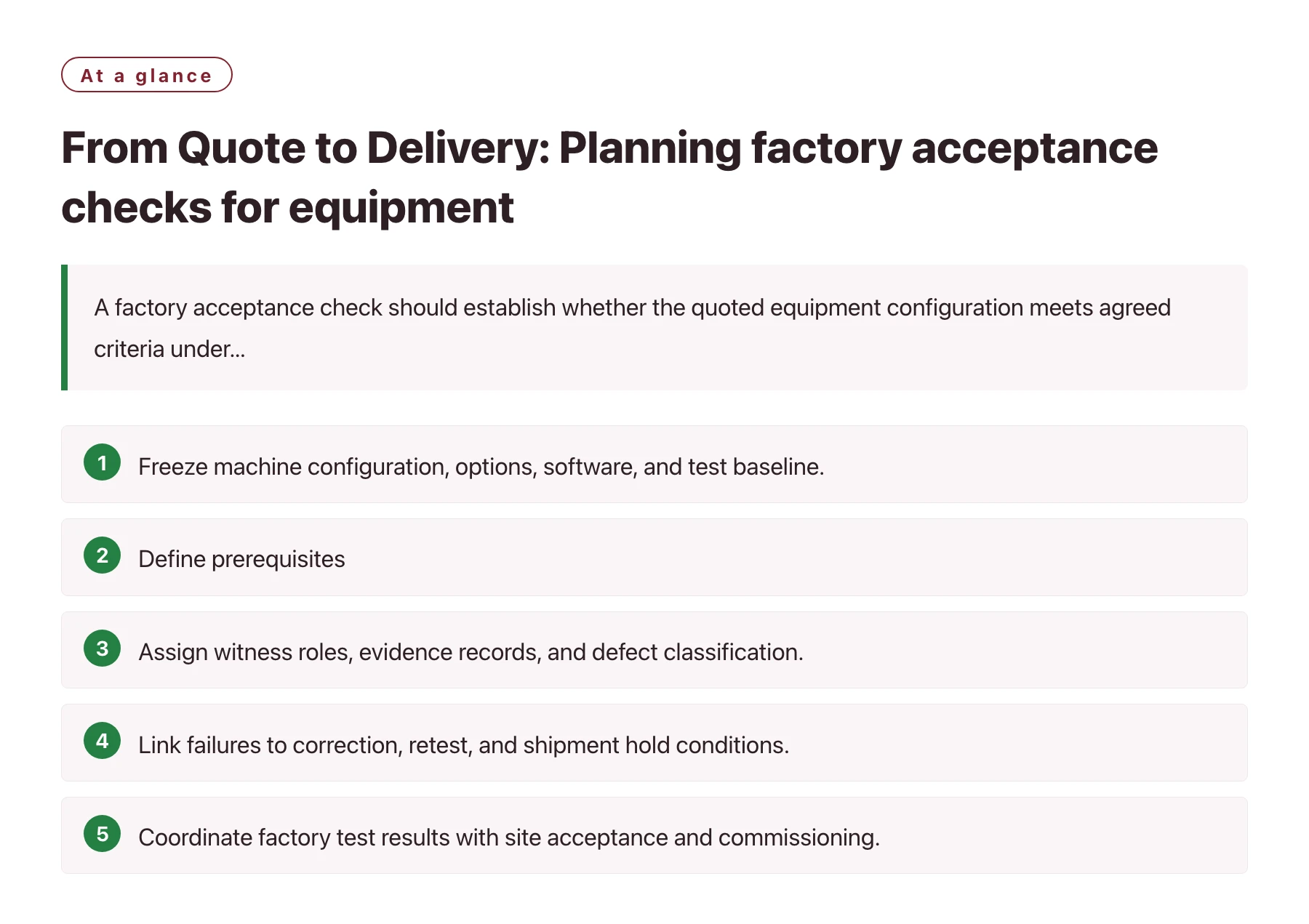
Key takeawaysFreeze machine configuration, options, software, and test baseline. · Define prerequisites, test materials, duration, measurements, and pass criteria. · Assign witness roles, evidence records, and defect classification. · Link failures to correction, retest, and shipment hold conditions. · Coordinate factory test results with site acceptance and commissioning.
The acceptance plan should turn performance expectations into a repeatable test and a decision that both buyer and supplier can document.
1. Define the acceptance decision
Clarify whether the factory check supports a progress milestone, technical approval, shipment release, or final contract acceptance. Separate these decisions if they occur at different times or require different evidence. Name the buyer and supplier representatives authorized to sign results or accept deviations.
Review contract wording, purchase order, specification, approved drawings, and offer revision. If documents conflict, resolve the precedence and interpretation before testing. Do not rely on an acceptance label whose consequences for payment, correction, or delivery are unclear.
2. Freeze the machine configuration
Identify machine model, serial or build number, tooling, options, guards, sensors, drives, control hardware, software version, recipes, interfaces, and included accessories. Link the test baseline to the approved bill of supply and current drawings.
Record changes since order award and confirm which require approval or retest. A demonstration unit or development build may not match the machine shipping to the buyer. Require confirmation that tested configuration and production configuration are equivalent within the agreed scope.
3. Set prerequisites and test environment
List utilities, foundations or support, input material, operator roles, tooling, safety access, ambient conditions, and upstream or downstream interfaces needed for testing. State which party provides each item and what happens if a prerequisite is missing.
Specify whether tests use representative production material or an agreed substitute. If the buyer cannot attend, define remote witness options, video evidence, data capture, and how questions will be answered. Set a realistic test duration that allows repeated cycles and investigation of intermittent faults.
4. Turn performance claims into measurable criteria
For each requirement, define metric, method, instrument, sampling period, unit, tolerance, operating condition, and acceptance limit. Examples may include throughput, output quality, repeatability, changeover, alarms, reject handling, or cycle time when relevant to the application.
Define what data is recorded and who verifies calculations. Check that the test sequence matches the supplier’s quoted assumptions. A nominal speed test without representative loading or product quality measurement may fail to demonstrate real production capability.
5. Include normal operation and fault scenarios
Test startup, normal operation, changeover, stopping, restart, alarm response, material interruption, and recovery behavior that are within the accepted scope. Define safe operating conditions and access controls for each test. Do not ask personnel to bypass safeguards to achieve an acceptance result.
ISO 12100 gives general principles for machinery risk assessment and risk reduction. The test plan should be reviewed by qualified safety personnel and should not be treated as a replacement for applicable machine-specific or local requirements. [1]
6. Assign witness roles and evidence responsibilities
State who operates the machine, observes, records data, approves methods, and can call a pause. Define buyer access to control screens, logs, alarms, measurements, and relevant production records. Agree how confidential information and video are handled.
Record attendees, date, location, machine identity, configuration, instruments, calibration status where relevant, test conditions, results, photos, and open issues. Preserve raw data and signed report revisions. A summary conclusion should be traceable to observations and measurements.
7. Classify findings and agree remedies
Define critical, major, minor, or punch-list classifications based on function, safety, performance, and contractual impact. State which findings fail acceptance, which permit conditional continuation, and which can be closed at the buyer site. Assign owner and due date to each issue.
For a failed test, define containment, root cause, correction, retest scope, and approval authority. If retest changes configuration or method, document it. A supplier promise to fix an issue later is not equivalent to verified closure unless the contract explicitly permits it.
8. Link acceptance results to payment and shipment
Map signatures, reports, open findings, and retests to payment milestones and shipment hold conditions. Specify which records must be complete before release, including manuals, drawings, software backups, spare parts, and export packing details. Ensure the logistics team sees the current acceptance status.
Define how a conditional pass works: affected items, risk owner, interim controls, due date, buyer approval, and whether dispatch is allowed. Avoid ambiguous statuses that the supplier interprets as permission to ship while the buyer still expects corrective action.
9. Prepare site acceptance and commissioning
Identify tests that must be repeated after installation because the factory setup cannot represent site utilities, integration, foundation, operator training, or real inputs. Define who supplies commissioning labor, connection work, consumables, and access.
Carry open factory issues into a site punch list without losing original evidence. Confirm acceptance criteria, timing, retest availability, and support response. A signed factory report should not be mistaken for proof that every site interface has been commissioned.
10. Close the record and preserve the baseline
At test close, issue a final report with results, limitations, open actions, approved deviations, signatures, and machine configuration. Store the record with purchase order, drawings, test data, shipping documents, and site acceptance evidence. Identify who owns the accepted configuration file.
Buyers arranging JS Sourcing can align machine specifications, factory test, shipment release, and commissioning in one acceptance plan. Reopen approval after changes to configuration, control software, safety devices, tooling, or performance claims that could invalidate prior results.
Sources
Frequently asked questions
Is a factory demonstration automatically an acceptance test?
No. It must use the agreed configuration, conditions, methods, criteria, evidence, and decision authority.
Can equipment ship with open findings?
Only when the contract and authorized buyer decision permit it, with scope, risk, owner, and closure date recorded.
Should all factory tests be repeated on site?
Repeat tests that depend on installation, utilities, interfaces, site conditions, or real production inputs.
What if the tested machine differs from the ordered configuration?
Record the difference, assess impact, obtain approval, and define which tests must be repeated before release.