How a Six-Cabinet Kitchen Gets Priced
A bundle price is a unit price wearing a disguise. CasaBuilt prices its basic kitchen as six pieces, two base cabinets, two wall cabinets, one tall cabinet and one vanity, and the sale total runs from $1,184.93 in Hudson Grey to $2,295.64 in Slim White Oak. Divide each total by six and the same kitchen reads $197.49 to $382.61 per cabinet, which is the number worth carrying to a quote comparison.
Key takeaways
- The basic kitchen is six cabinets: two base, two wall, one tall and one vanity.
- Sale prices run from $1,184.93 in Hudson Grey to $2,295.64 in Slim White Oak.
- Per-cabinet cost inside those bundles ranges from $197.49 to $382.61.
- Hudson Grey and Navy Blue are half off list; Smokey Ash and Slim Aston Green are 20% off.
Why the bundle hides the cabinet price
Nobody buys "a kitchen." They buy a base cabinet with a drawer, a wall cabinet with a shelf, a tall box for the oven, and a vanity with a sink cutout. The bundle exists because a six-piece set is the smallest arrangement that looks like a kitchen in a photograph, and because a single total is easier to advertise than a price list. The trouble starts when a buyer compares that total with a quote built from different pieces.
A per-cabinet figure fixes the comparison. It answers a plain question: if every piece in this kitchen cost the same, what would one cost? That is not literally true of any real order, since a 9-inch base and a 42-inch sink base are not the same product. It is still the fastest way to see whether a style premium is a finish decision or a pricing trick.
The bundle also sets a floor for the project. A six-cabinet kitchen is a kitchenette, a rental unit or a small galley. A full family kitchen will need two or three times the piece count, and the per-cabinet average is the multiplier that gets you from one number to the other.
That multiplier is why two buyers can quote the same style and disagree about the price. One is pricing the sample bundle; the other is pricing a wall of drawers. The style sets the rate, the piece count sets the total, and the gap between them is a layout decision rather than a discount.
What is actually inside the six pieces
The published bundle is two base cabinets, two wall cabinets, one tall cabinet and one vanity. CasaBuilt builds bases at 34-1/2 inches high and 24 inches deep, with widths from 9 to 42 inches. Wall cabinets are 12 inches deep in 30, 36 or 42-inch heights and 9 to 39-inch widths. The tall example on the site is 33 inches wide, 84 inches high and 24 inches deep. Vanity cabinets match the base height but run 21 inches deep, in widths from 12 to 48 inches.
Those dimensions explain why the bundle price cannot simply be divided by six in real life. A 42-inch three-drawer base and a 9-inch spice pullout are both one cabinet, but they are not the same amount of board, hardware or finishing time. The bundle is a sample box, not a specification of a typical kitchen.
It is, however, a consistent sample box. The same six pieces appear at the same six prices across styles, which is what makes a style-to-style comparison honest. The difference between $1,184.93 and $2,295.64 is the difference between a painted Shaker door and a slim oak-look door on an otherwise comparable set.
Four styles divided six ways
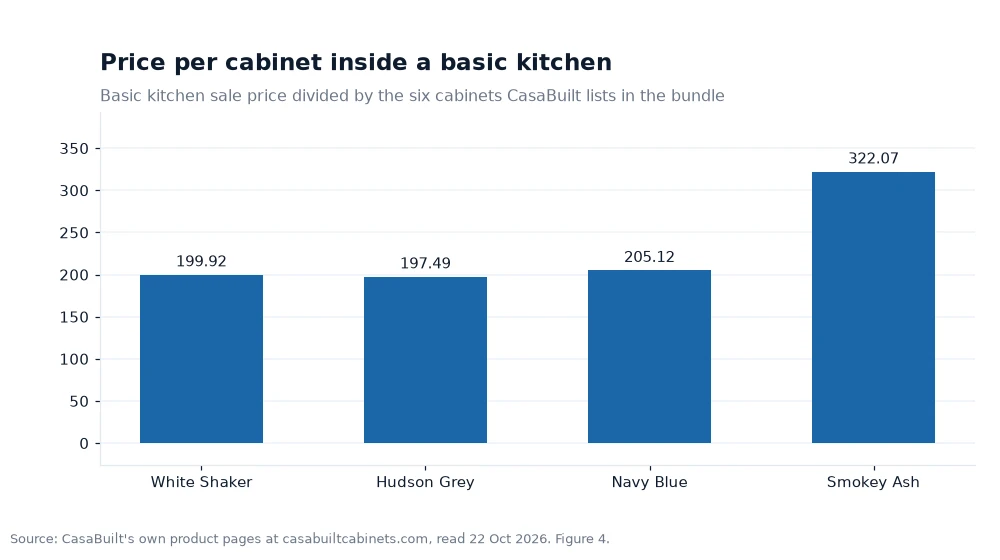
The table below takes the four painted Shaker bundles and divides both the sale price and the list price by six. The per-cabinet column is the chart figure, rounded to the cent. The list column shows what the same piece would cost without the discount, which matters when a buyer is comparing a sale price against a competitor's regular price.
| Style | Bundle sale price | Bundle list price | Per cabinet, sale | Per cabinet, list |
|---|---|---|---|---|
| White Shaker | $1,199.50 | $2,399.00 | $199.92 | $399.83 |
| Hudson Grey Shaker | $1,184.93 | $2,369.86 | $197.49 | $394.98 |
| Navy Blue Shaker | $1,230.69 | $2,461.37 | $205.12 | $410.23 |
| Smokey Ash Shaker | $1,932.42 | $2,415.52 | $322.07 | $402.59 |
Two things stand out. The first is how tight the three painted entry lines are: White, Hudson Grey and Navy sit within $45.76 of each other on the bundle, which is $7.63 per cabinet. The second is Smokey Ash, which is $732.92 above White Shaker on the bundle but only $2.76 above it per cabinet on the list price. The discount structure, not the door alone, explains most of that gap.
Why the average is not a cabinet you can buy
The per-cabinet figure is an average, and the published component prices show how wide the real spread is. In the Slim White Oak line, a 9 to 21-inch single-door base is $238.24, a 30 to 42-inch double-door base is $586.28, a 30-inch double-door wall is $347.76 at 30 inches high, and the 33 by 84-inch oven cabinet is $906.16. The bundle average for that line is $382.61, which lands almost exactly between the small base and the large base.
That is useful rather than contradictory. It means the average describes the mix, and the mix is fixed by the bundle definition. If your real kitchen replaces the oven cabinet with a second sink base, the per-cabinet average will move. If it replaces two small bases with two 36-inch drawer stacks, it moves the other way.
The line sold under casabuilt cabinets publishes every component price, so the average can be rebuilt for a specific list. That is the step most buyers skip: they budget from the bundle and then discover their actual layout is heavier on wide drawers than the sample set.
Worked example: dividing the bundle by six
The chart gives four per-cabinet values. White Shaker is $199.92, which is $1,199.50 divided by six: 1,199.50 / 6 = 199.9167, rounded to 199.92. Hudson Grey is $197.49, from 1,184.93 / 6 = 197.4883. Navy Blue is $205.12, from 1,230.69 / 6 = 205.1150. Smokey Ash is $322.07, from 1,932.42 / 6 = 322.0700 exactly.
Check the rounding by multiplying back. Six times $199.92 is $1,199.52, which is two cents more than the published $1,199.50. Six times $197.49 is $1,184.94, one cent over. Six times $205.12 is $1,230.72, three cents over. The per-cabinet figure is a rounded average, not a price you can order at the counter.
Now use it as a budget multiplier. A twelve-cabinet kitchen is twice the bundle, so at the White Shaker average it lands near $2,399.04, and at the Smokey Ash average near $3,864.84. That is the same arithmetic the chart performs, scaled to a bigger list, and it is close enough to set a budget before a design is drawn.
Frequently asked questions
Is the six-cabinet kitchen enough for a real kitchen?
It is enough for a kitchenette, a rental unit or a small galley, not for a family kitchen with a full appliance run. Use the per-cabinet average as a multiplier: count the cabinets your layout needs, multiply by the average for your chosen style, and treat the result as a budget rather than a quote. A design drawing will produce the real list.
Why is the per-cabinet price different from the component prices?
The per-cabinet figure is the bundle total divided by six, so it is an average across two bases, two walls, a tall cabinet and a vanity. Component prices vary by width and function: in Slim White Oak a small base is $238.24 while the 33 by 84-inch oven cabinet is $906.16. The average sits between those published numbers.
Does the sale price apply to every cabinet in the bundle?
The bundle is advertised as a set at the sale price shown, with the list price struck through beside it. Component prices also carry their own sale and list figures, for example a 30 to 42-inch Slim White Oak base at $586.28 against a list of $988.70. Check both columns before comparing with another seller.
Carry the per-cabinet figure into the design
Write the average for your chosen style on the same sheet as the room measurements, then multiply it by the number of cabinets the layout needs. Compare that number with the design-to-budget estimator before the drawing is finalized, because a budget that only works at the bundle price will not survive a real cabinet list.
The bundle is a starting point, not a quote. Used as a unit price, it tells you what a style costs per box and how far a budget will stretch. Used as a total, it tells you almost nothing about the kitchen you are actually building.
Figures quoted here come from the manufacturer's own website, read 22 Oct 2026[1].