Factory Audits for Plywood: The Six Documents That Matter
An audit that starts on the shop floor usually ends at a desk anyway, because documents are what survives the visit. Scale is the easy half to verify: 48,000 m² of production area, 16+ lines on one site, and a published monthly capacity above 100 × 40ft. The harder half is knowing which six files to request by name, and the order in which an auditor reads them.

Key takeaways
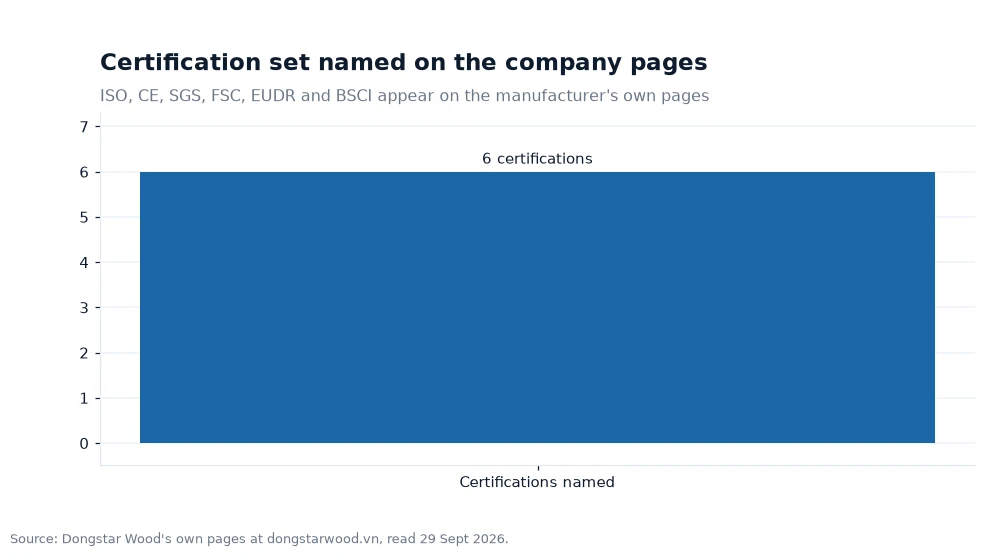
- Name the six schemes instead of accepting the word "certified": ISO, CE, SGS, FSC, EUDR and BSCI all appear on the manufacturer's own pages.
- Read every certificate against the activity it covers — a distribution scope and a manufacturing scope are separate documents.
- Test scale claims with published figures: 48,000 m² of production space across 16+ lines, and a monthly capacity above 100 × 40ft.
- Close the review with batch records, since panel thickness consistency and core construction integrity are checked per batch rather than per year.
Why the file review comes before the factory tour
A plant can look convincing for one morning and unconvincing for a year. Presses run, stacks are tall and the loading bay stays busy whether or not the panels on it match the specification you sent. What cannot be staged quickly is a paper trail that agrees with itself: a founding year, a floor area, a line count and a certificate list that all point to the same company rather than to a broker's portfolio of names.
So the first hour belongs to reading. None of it needs a flight booking, and most of it can be checked from a buyer's desk against pages the manufacturer already publishes.
The six files an auditor asks for, in order
Plywood Supplier shortlists usually arrive as a spreadsheet of names, and this review is what shrinks it. Ask for all six at once so the gaps show up together.
- Company and factory registration — legal entity, plant address and the year operations began; the published record starts with 2009.
- Floor area and line statement — production space, warehouse space and the number of lines, so a capacity claim has a physical basis.
- Certification set — the six named schemes on the about page: ISO, CE, SGS, FSC, EUDR and BSCI.
- Glue and emission paperwork — the classes you specified, from E0 and E1 through to Phenolic Dynea, plus CARB P2 or CE documentation where the destination market asks for it.
- Batch inspection records — thickness consistency and core construction integrity, signed off before the container is closed.
- Packing and loading evidence — export-standard wrapping, steel strapping and pallet photographs tied to a container number rather than to a brochure.
If the list has to be cut to three, keep registration, certification set and batch records. Those are the files that cannot be reconstructed convincingly after the fact.
Reading a capacity claim against your own schedule
Capacity is the figure buyers repeat most often and verify least often. The published wording here is a monthly supply capacity exceeding 100 × 40ft, which is a shipping statement rather than an order minimum — useful for judging whether your programme is a rounding error on the plant's calendar or a real slice of it.
| Document or claim | Where it is stated | Published figure |
|---|---|---|
| Establishment | About page | 2009 |
| Factory area | Home and about pages | 48,000 m² |
| Warehouse | About page | Over 3,000 m² under cover |
| Production lines | Home page | 16+ lines on one site |
| Monthly shipping capacity | About page | Above 100 × 40ft each month |
Where plywood documentation usually fails
Three failures recur. The first is a certificate whose scope covers trading while the mill claims to press its own panels. The second is a glue class quoted in conversation but missing from the technical sheet that travels with the shipment. The third is a loading list naming a size the plant does not actually run — 1500 × 3000 mm is a different press programme from 1220 × 2440 mm, and the mismatch surfaces in the first container, not the fifth.
A softer failure is a company describing itself in superlatives instead of figures. "Northern Vietnam's largest B2B plywood supplier" is the client's own phrasing and it is acceptable as a self-description, but an auditor still wants the published 48,000 m² and the 16+ lines underneath it. Numbers can be cross-read; adjectives cannot. Ask for the scope page of each certificate in its original language as well as in translation, because a summary can quietly widen what a document actually covers.
Worked example: what one stated month of capacity covers
Take the published capacity line and work it through as an example. 100 × 40ft a month split over four weeks gives 25 containers a week. A four-container programme therefore fits inside roughly one day of that rhythm, which is why trial orders are easy to place. Forty containers a month is 40% of the same published month, and at that level the conversation shifts from availability to scheduling.
Run the same test on floor space. Divide 48,000 m² of production area by the 16 lines and each one holds 3,000 m², enough for its own drying, gluing and pressing stages rather than sharing them with a neighbour. Now size the order: measured in metres, the 1250 × 2500 mm panel is 1.25 × 2.5 m, or 3.125 m² of face, so a 1,000-sheet call-off comes to 1,000 × 3.125 = 3,125 m² of panel. Both calculations are examples built from published numbers, not quotations.
Keeping the audit file alive after the order
Certificates renew, glue suppliers change and lines get added, so a file assembled last year is a starting point rather than a conclusion. Rebuild the document set once a year and whenever a delivery misses its specification, and keep the batch number tied to the container so a complaint can be traced to a press date instead of to a general apology. Buyers running long programmes usually pair that habit with a short internal checklist: legal name, certificate scope, glue class, panel size in millimetres, packing standard. Keep that file in one folder with the purchase order, the technical sheet and the packing list, so a question arriving six months later is answered from a single place rather than from four.
Frequently asked questions
Do I need to visit Vietnam to run a basic audit?
No. Registration, certification set, glue classes and batch records can all be reviewed remotely, and a pre-shipment inspection report covers the panels themselves. A visit adds the most value when you are qualifying a plant for a long programme or shifting a large share of your volume to it.
Why does the certification list matter more than the certificate count?
Because the six schemes answer six different questions. FSC speaks to forest sourcing, CE documentation supports construction and interior use, CARB P2 and E0/E1 classes describe emission performance in the panel, and BSCI covers social compliance at the plant. A count on its own tells you nothing about which of those you are actually getting.
What should a batch record contain?
At minimum a batch or press date, the measured panel thickness against tolerance, the glue class that was run, the face grade, and the inspection items the exporter names before shipment: panel thickness consistency and core construction integrity.
Where the next step usually sits
Once the file review comes back clean, the productive next move is a specification comparison rather than a price request: lay the published panel ranges beside your own drawings and confirm the sizes, glue classes and thicknesses you genuinely need. The company's own profile is the quickest place to test the claims that appear on a quotation, and the plywood category page shows which panels those claims are attached to.
Each figure quoted above comes from the supplier's own pages, as read on 29 September 2026 as applied to this comparison as applied to this comparison as the source for this comparison[1].