Vessel Configurations Explained: 2, 3, 4 and 5 Vessel Lines
Vessel count is the number that decides how a brewing day feels. Two vessels ask the brewer to wait while one tank finishes before it can start the next job; five vessels let several processes run at once. This article explains what each configuration adds, in plain terms, and works through the timings of a 1,000 litre batch on a two-vessel and a four-vessel line.
Key takeaways
- HGMC publishes 2, 3, 4 and 5-vessel configurations, powered by steam, direct fire or electricity.
- Extra vessels buy overlap, not quality: the same wort can be made in a two-vessel line, just more slowly.
- The published designs support both decoction and infusion mashing, so vessel choice does not lock the brewery to one method.
- Control level matters alongside vessel count: PID panels, PLC semi-automatic touch screens and fully automatic panels are all offered.
What each vessel in the set is doing
The Brewhouse range published by the manufacturer covers 2, 3, 4 and 5-vessel sets, so the question is not availability but how much overlap a brewery wants. Brewing is a chain of four jobs: mixing grist with hot water, separating the liquid from the spent grain, boiling the wort with hops, and settling the trub out before the wort goes to the fermenter. There is also a fifth job, heating water, that has to happen continuously and quietly in the background.
A two-vessel line combines those jobs into two shells, so mashing and lautering share one vessel while boiling and whirlpooling share another. A three-vessel line usually separates the whirlpool or adds a dedicated mash mixer, so the kettle is free while lautering finishes. A four-vessel line separates mash mixing and lautering into their own vessels, and a five-vessel line commonly adds a dedicated whirlpool or a separate hot liquor vessel, letting almost every step overlap with the next.
Two vessels: the shortest day, the tightest schedule
The two-vessel configuration remains the classic for small breweries because it uses the least floor space and the fewest fittings. Its weakness is sequencing: while the mash rests in the combined mash and lauter vessel, the second vessel is idle, and while the kettle boils, nothing can be lautered into it. Every process is bracketed by waiting.
This matters less than it sounds at craft volumes. If the brewery brews twice a week, waiting an extra half hour per batch is noise. If the plan is three turns a day to feed a busy taproom, the waiting becomes the schedule.
Two-vessel sets also suit breweries that intend to change recipes often and to keep maintenance simple. Fewer vessels means fewer valves, fewer jackets, less pipework to clean and less to go wrong on a Sunday.
Three, four and five vessels: what the extra tank buys
The third vessel is usually a whirlpool or a dedicated mash vessel. Either way it breaks a bottleneck: with a whirlpool standing alone, wort can settle while the next mash begins, and with a separate mash vessel the lauter tun can be filled from one batch while the next grist is being mixed somewhere else.
The fourth vessel commonly completes the pair, giving mash mixing and lautering their own vessels and the same for the kettle side. The gain is not speed of any single step but the near-elimination of standing time: by the time the kettle is empty, the next wort is ready. A fifth vessel, often a dedicated whirlpool or hot liquor tank, lets the kettle overlap with whirlpool settling as well.
All of this is about vessel geometry and scheduling rather than about the beer. Because the published designs accept both decoction and infusion methods, a brewery can choose a two-vessel set today and still decoct, or order a five-vessel set for a high-turnover brewery without changing its approach to recipes.
| Configuration | Typical vessels | Effect on the brew day |
|---|---|---|
| 2-vessel | Mash and lauter combined, kettle and whirlpool combined | Every step is sequential; longest day per batch |
| 3-vessel | Added whirlpool or mash vessel | First overlap; boiling frees the lauter side |
| 4-vessel | Separate mash mixer and lauter tun, kettle and whirlpool | Little standing time; two batches can nearly interleave |
| 5-vessel | Additional whirlpool or hot liquor vessel | Maximum overlap; designed for multi-turn days |
Output is set by batches, configuration sets the ceiling
Configuration does not change how much liquid a batch holds; it changes how many batches can be squeezed into a working week. At 1,000 litres per batch and twelve brews a month, a brewery makes 144,000 litres a year, and the chart below shows how that figure moves with the brewing rate: 96,000 litres at eight brews a month, 144,000 at twelve, 192,000 at sixteen and 240,000 at twenty.
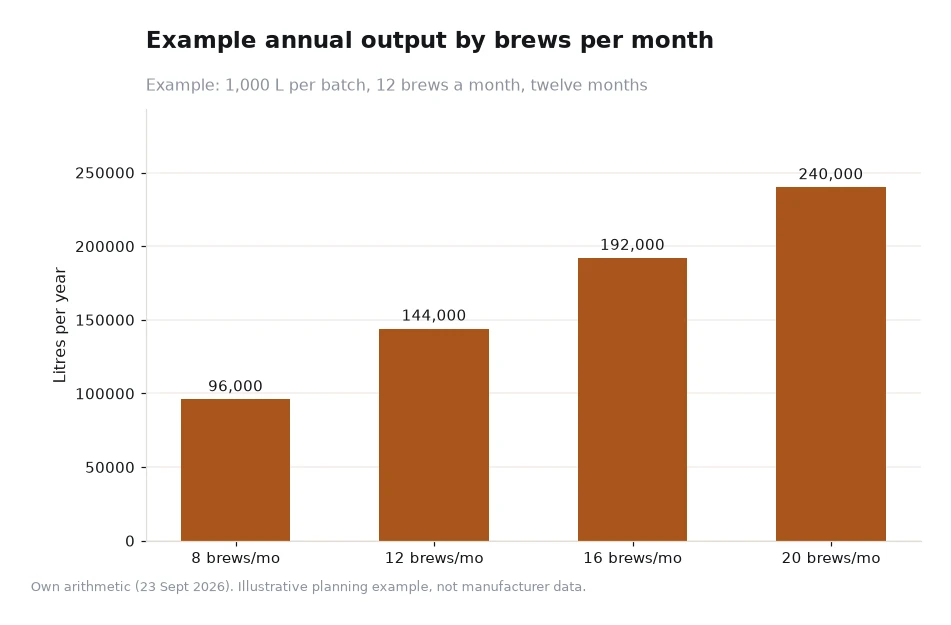
The point of a four or five-vessel set is that it makes the right-hand bars of that chart achievable without a second shift. A two-vessel house that wants sixteen brews a month can do it, but the brew days get long and the waiting time is paid in labour rather than in steel.
Worked example: two vessels versus four on the same batch
The timings below are an example and are stated as assumptions: a 1,000 litre batch, mash rest of 60 minutes, lautering 60 minutes, boil 60 minutes, whirlpool 30 minutes, and transfer with cleaning 30 minutes. Your own times will differ with gravity, grist and boiler.
On a two-vessel line every step follows the last, so the day is 60 plus 60 plus 60 plus 30 plus 30, which is 240 minutes or 4 hours per brew. Two brews fill an 8-hour shift with no slack. Twelve brews a month therefore need 48 hours of brewhouse time, or six working days.
On a four-vessel line the mash and lauter stages move to their own vessels, so lautering can begin as soon as the mash is transferred and the kettle stays busy. Take 30 minutes out of the sequence and the batch runs in about 3.5 hours, or 42 hours for twelve brews a month. Add a dedicated whirlpool and the overlap improves again, allowing a third turn on a long day.
The difference of 6 hours a month looks small; the difference between a plant that can brew three times a day and one that cannot is the difference between 240,000 and 144,000 litres a year at the same batch size. That is the real argument for extra vessels, and it should be tested against the brewing rate the market will actually support.
Frequently asked questions
Is a four-vessel line harder to clean than a two-vessel line?
It has more surfaces, more valves and more pipework, so cleaning takes longer in absolute terms. Most of that work is handled by the clean-in-place system and the automatic control options HGMC offers, including PLC panels with curve indication and production-record printing, which log what was cleaned and when.
Can a two-vessel line be upgraded later?
It can, if the original layout reserved floor space and the pipework was sized with expansion in mind. Adding a whirlpool or a fourth vessel to a working brewery is disruptive, so it is worth deciding at the drawing stage whether the site has room for the next step.
Choose the configuration from the brew calendar
Write down the number of brews you need in a normal week and the number you need in your best week, then compare those two numbers with the standing time of each configuration. The supplier can then size vessels, heating method and control level around that calendar rather than around a batch size alone. HGMC publishes steam, direct-fire and electric heating options, three control levels from PID panels to fully automatic PLC systems, and free 2D, 2.5D and 3D design work for layout and piping, so the vessel question and the layout question can be answered together.
The supporting pages are worth reading side by side: the micro craft brewery range covers 1,000 to 3,000 litres for breweries producing 18,000 barrels or less a year, while the larger plant listings describe equipment up to 100 HL. Delivery is published as 90-150 days from deposit to door, and the warranty covers tank accessories and electronic components for 6 years against manufacturing defects from the factory, used within scope. When the configuration is chosen, the next step is a layout drawing rather than another comparison; the contact desk takes the request from there.
Figures in this article come from the manufacturer's own website, read 23 Sept 2026, including the published 2, 3, 4 and 5-vessel configurations, heating methods, control levels, capacity ranges, the 90-150 day delivery window and the 6-year warranty wording; the brew-day timings and annual volumes are this article's own arithmetic with assumptions stated in the text. Details: [1]