What Sizes Are Available for Wholesale Coffee Packaging?
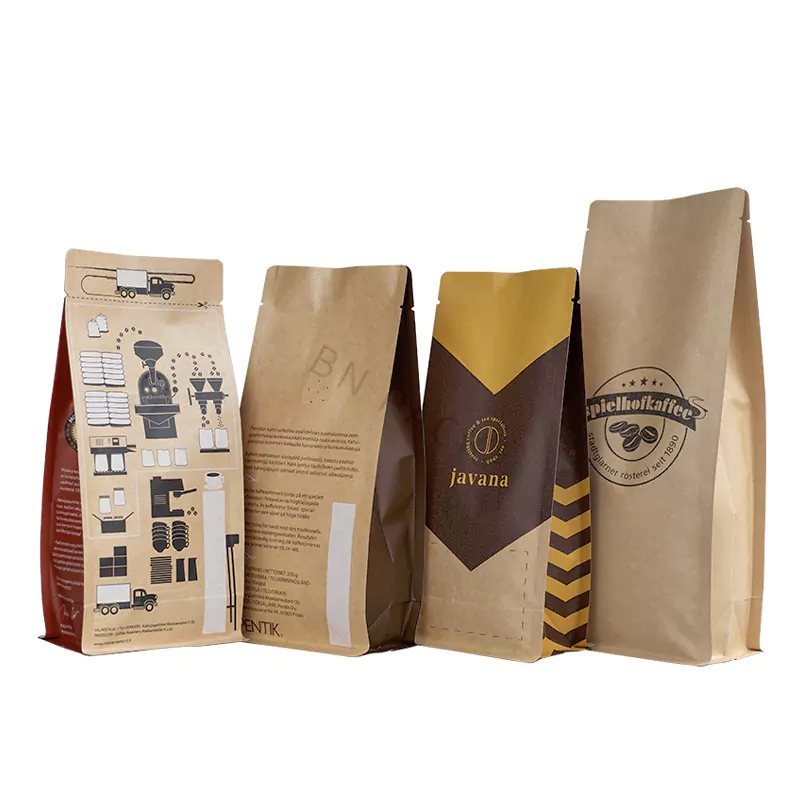
Wholesale coffee packaging commonly ranges from 100 g sample pouches to 5 lb commercial bags. Retail formats often sit between 200 g and 500 g, while cafés, offices, hotels, and foodservice buyers commonly use 1 kg, 2 kg, or 5 lb packs. A 250 g bag holds about 14 brews at an 18 g dose; a 1 kg bag provides about 55 doses at the same rate. Bag dimensions still vary because whole beans, ground coffee, roast level, gusset depth, valve placement, and required headspace change the usable volume. Net weight should be selected first; physical bag dimensions should follow product-fill testing.
A coffee bag is sold by physical dimensions but the coffee inside is sold by net weight, so capacity cannot be determined from width and height alone. A 250 g whole-bean fill usually occupies more space than 250 g of finely ground coffee because the spaces between intact beans increase bulk volume. Dark roasting also reduces bean mass through moisture and volatile loss while increasing bean size, so two coffees with identical net weights may not fill a pouch to the same height. That is why suppliers normally ask for product type before recommending a stock size.
The size range below covers most retail and foodservice applications, although dimensions vary by manufacturer and pouch construction.
| Nominal fill | Approx. imperial equivalent | Common use | Typical packaging format |
|---|---|---|---|
| 100 g | 3.5 oz | Samples, tasting sets | Small stand-up pouch |
| 150 g | 5.3 oz | Microlots, gifts | Stand-up or flat pouch |
| 200–250 g | 7–8.8 oz | Specialty retail | Stand-up or flat-bottom |
| 340 g | 12 oz | North American retail | Flat-bottom, side gusset |
| 454–500 g | 1 lb / 17.6 oz | Household use | Flat-bottom, quad-seal |
| 1 kg | 2.2 lb | Cafés, offices, foodservice | Side-gusset, quad-seal |
| 2 kg | 4.4 lb | High-volume foodservice | Reinforced gusset bag |
| 5 lb | 2.27 kg | Commercial use | Large side-gusset bag |
The 100–150 g range works well when the coffee itself has a high unit price or when customers are expected to try several origins in one purchase. At an 18 g brew dose, 100 g provides roughly 5.5 servings and 150 g provides about 8.3. The small quantity limits exposure after opening, although the packaging cost per kilogram of coffee is higher because every unit still needs printing, sealing, handling, carton space, and often a valve. In a 2024-style subscription model with three 100 g coffees, the buyer receives 300 g total while the roaster gains three separate branding surfaces rather than one.
That small-format logic leads naturally to 200–250 g packaging, which is common among specialty roasters because it balances trial size with repeat use. At 18 g per brew, a 250 g pouch provides around 13.9 doses; at 15 g, it provides 16.7. The Specialty Coffee Association uses a Gold Cup reference ratio of 55 g of coffee per liter of water in brewer testing, so a 250 g bag corresponds to about 4.5 liters of brewed coffee at that ratio. SCA certification testing also evaluates at least 5 brewers and at least 10 brew cycles per brewer, with target soluble concentration of 1.15%–1.45%.
A “250 g bag” is a fill target, not a universal pouch dimension. The same printed capacity can require a different gusset depth when the product changes from ground coffee to whole beans.
For buyers working in ounce-based retail markets, 12 oz is another established format. Twelve ounces equals about 340 g, providing approximately 18.9 doses at 18 g each. Compared with a 250 g pouch, the coffee quantity rises by about 36%, so the bag generally needs greater height, width, gusset depth, or a combination of all three. A roaster switching from 250 g to 340 g should not simply enlarge artwork by 36%; zipper position, seal zones, valve clearance, and the usable front panel also change with the physical structure.
The 454 g or 1 lb format sits one step above 12 oz and suits customers who brew coffee daily. At an 18 g dose, 454 g produces about 25 servings, while 500 g produces about 27.8. A two-person household using 36 g per day would consume a 500 g bag in roughly 14 days. That usage period helps explain why larger retail packs usually benefit from a reclosable zipper: the bag may be opened more than 10 times before it is empty, increasing the importance of controlling air exposure between uses.
Packaging structure becomes more important once fill weight moves toward 500 g and above. Stand-up pouches rely on an expanding bottom gusset, flat-bottom bags spread the load across a defined base, and side-gusset bags expand vertically along both sides. A 500 g flat-bottom bag can therefore look shorter and more rectangular than a 500 g stand-up pouch even when both contain the same coffee. For brand owners using kraft paper coffee bags, the same sizing rule applies: the outer paper appearance does not determine capacity; internal laminate thickness, gusset geometry, zipper position, and coffee density do.
A 1 kg pack moves the application from normal retail toward cafés, offices, restaurants, and hotel service. At 18 g per espresso or brewed-coffee dose, 1 kg provides about 55.6 portions; at 20 g, it provides 50. A café using 4 kg per day would open four 1 kg bags, while the same volume packed in 250 g units would require 16 bags. That is a 75% reduction in the number of packages opened, handled, and discarded during service, although it does not automatically produce a 75% reduction in packaging material because larger pouches require heavier structures.
The larger mass also changes what should be checked during pouch approval. A one-kilogram bag places four times the coffee weight of a 250 g pack on the bottom seals during lifting and transport. Suppliers may respond with wider seals, stronger laminated films, deeper gussets, or a quad-seal construction that distributes the product more evenly. A bag that performs well during a static shelf test can still fail after repeated drops or compression inside a shipping carton, so buyers should test filled samples under the same handling conditions planned for commercial distribution.
At 2 kg and 5 lb, consumption speed becomes more relevant than retail presentation. A 5 lb package contains about 2.27 kg, equal to roughly 126 doses at 18 g each. A busy foodservice account using 1 kg per day can finish it in a little over two days, but an office using only 100 g per day would need more than 22 days. Larger packages therefore make more sense when turnover is fast enough to prevent a single opened pack from remaining in service for several weeks.
Larger bags reduce the number of individual packs used per kilogram, but they also require stronger seals and greater resistance to puncture, flexing, and carton compression.
Whole-bean and ground coffee should also be treated separately during dimensional testing. Grinding changes how particles settle, usually allowing smaller particles to occupy void spaces that exist between whole beans. The fill line can therefore move even when the net weight remains unchanged. A packaging test should use the final roast and grind rather than substitute material, because a 1 kg fit test performed with one coffee does not prove that another 1 kg coffee will produce the same filled profile.
Headspace adds another variable. A pouch should not be filled to the zipper or top seal because filling equipment needs clean sealing surfaces, while roasted coffee can continue releasing carbon dioxide after packing. The amount of free space varies by production method, but a bag filled so tightly that beans reach the sealing area can produce contamination in the heat-seal zone. Even a few trapped coffee particles can interfere with seal contact, which matters more on automated lines producing hundreds or thousands of packages per shift.
A one-way degassing valve affects layout rather than nominal capacity. The valve occupies part of the front or back panel and needs enough clearance from the top seal, zipper, artwork, and folds. Freshly roasted coffee can release gas for days after roasting, so many roasters use valves to allow internal gas to leave without leaving a permanently open path through the package. The valve does not replace a suitable oxygen- and moisture-barrier laminate; both features address different parts of package performance.
Label space becomes more restricted as packs get smaller. In the United States, FDA guidance requires the net quantity statement for packaged food to appear in the bottom 30% of the principal display panel, and labels generally show both U.S. customary and metric quantities. FDA examples include formats such as “15 oz (425 g).” A compact 100 g pouch therefore has to accommodate mandatory labeling, branding, roast information, barcode placement, and seal areas within a much smaller printable surface than a 1 kg pack.
That legal requirement makes nominal capacity only one part of the artwork process. FDA guidance also explains that principal display panel area influences the permitted minimum type size for the net quantity statement. For a rectangular package, panel area is calculated from height multiplied by width; for a cylindrical package, FDA uses 40% of circumference multiplied by height. A company reducing pouch width to save material should therefore recheck the available labeling area rather than reuse the previous layout unchanged.
Another sizing issue appears when procurement teams compare stock and custom pouches. Stock bags usually come in fixed width-height-gusset combinations and may cover fills such as 250 g, 500 g, and 1 kg with little development work. Custom bags allow narrower shelves, different proportions, larger front panels, or dimensions adapted to an automated filler, but order quantities can increase substantially. A project using 50,000 bags per design has more room to justify custom dimensions than a launch requiring only 2,000 units.
Shipping efficiency adds a further check. A bag that stands 30 mm taller than necessary may not look problematic by itself, but carton volume accumulates across hundreds of units. If 20 filled bags are packed per case and excess dimensions increase case volume by 8%, 100 cases require roughly 8% more cube before pallet configuration is adjusted. Freight pricing depends on route and carrier, but volume efficiency becomes increasingly relevant when shipments move by air or when pallet positions are limited.
For that reason, testing should include the secondary carton rather than stop at the individual pouch. Fill 10–20 representative bags, allow them to settle, close them using the production sealing method, and pack them exactly as they will ship. Record finished width, height, thickness, gross weight, seal appearance, valve position, and carton fit. A sample of 20 packs provides far more useful dimensional information than checking a single empty pouch because flexible packages vary after filling and settling.
Buyers can use a short specification set when requesting prices:
-
Net fill: 100 g, 250 g, 340 g, 500 g, 1 kg, 2 kg, or 5 lb.
-
Product form: whole bean or specified grind.
-
Roast profile used for sample filling.
-
Bag style: stand-up, flat-bottom, side-gusset, or quad-seal.
-
Closure: zipper, tin tie, or heat seal only.
-
Valve: required or not required.
-
Material construction and barrier target.
-
Filling method: hand fill, semi-automatic, or automatic.
-
Order volume: for example 5,000, 25,000, or 100,000 units.
-
Final market and labeling requirements.
A supplier receiving all 10 data points can size the pouch more reliably than one receiving only “500 g coffee bag.” The difference matters because commercial packaging must satisfy three conditions at once: it must physically hold the target weight, run through the packing process, and leave sufficient room for seals and legal information.
Net weight verification should also be based on the coffee alone. FDA guidance states that container, wrapper, and packaging material are excluded from declared net quantity; its example subtracts an empty container and wrapper from the filled weight to determine food weight. For a coffee producer packing thousands of units, tare settings and scale checks should therefore be based on the actual pouch, valve, zipper, and label configuration used on the line.
A practical size trial can compare three nearby dimensions rather than approving the first pouch that accepts the coffee. For a planned 500 g product, fill 20 samples in each candidate size, giving a 60-bag comparison. Measure headspace, filled thickness, seal contamination, standing stability, carton count, and visual fill level. If one option leaves 25 mm less unused headspace while still sealing cleanly, the smaller format may improve shelf proportions and case packing without changing net weight.
The same method works when moving from retail to wholesale. A roaster selling 250 g packs may assume a 1 kg pouch should simply have four times the internal space, but flexible packaging does not scale in a simple one-to-four ratio because surface area, gusset expansion, seals, and bag proportions change together. The 1 kg version needs to be tested as its own package, particularly when changing from a stand-up pouch to a side-gusset or quad-seal structure.
For most ranges, 100–150 g suits samples and high-priced coffees, 200–340 g covers specialty retail, 454–500 g supports frequent household use, and 1–5 lb formats fit higher-volume customers. The final dimensions should be approved only after the real coffee has been filled into production-equivalent samples, because weight, bulk volume, package geometry, headspace, valves, seals, labeling area, carton fit, and handling performance all affect whether a nominal size works in commercial use.